
Trump Promised Americans Gas Prices Would Fall and Said When
Gas hit $4 a gallon for the first time since 2022 – and Americans were told relief was days away.
For 24 hours, markets believed it.
Then came a primetime address that changed everything.
What Trump Said Before His Iran War Speech Moved Markets A Good Direction
Trump was direct when reporters asked him about $4 gas Tuesday.
"All I have to do is leave Iran, and we'll be doing that very soon, and they'll come tumbling down," he told reporters at the White House.
He said he expected U.S. forces out in two to three weeks.
White House press secretary Karoline Leavitt backed him up, saying that once Operation Epic Fury is complete, gas prices will return to the levels Americans saw before the war – and that Trump remains committed to putting more money back in the pockets of hardworking families.
Markets moved instantly – WTI crude dropped nearly 2% Wednesday morning as traders priced in an exit ramp.
Wednesday afternoon, Trump posted on Truth Social that Iran's new president had asked for a ceasefire – briefly sending stocks higher and oil lower.
GasBuddy's head of petroleum analysis Patrick De Haan had already calculated that Americans were spending roughly $370 million more on gasoline every single day compared to a month ago.
A Stanford economist projected the average household would spend up to $857 more on gas for the rest of 2026 than before the war.
So Wednesday morning’s downward trend on prices looked like the start of welcome relief.
Then came the speech.
Wednesday night, Trump vowed to hit Iran "extremely hard" over the next two to three weeks – offering no exit timeline, no plan to reopen the Strait of Hormuz, and no concrete path to lower prices.
West Texas Intermediate futures surged 11% to above $111 a barrel by Thursday morning – a brutal reversal from the brief hope of the day before.
The Dow dropped more than 600 points at its low.
Asia-Pacific markets followed – South Korea's Kospi fell 4.5%, Japan's Nikkei dropped 2.4%.
Federal Reserve Chair Jerome Powell told a Harvard economics class Monday that the country is now absorbing a third major supply shock – after COVID and tariffs – and that no one knows how large it will be.
The Strait of Hormuz Closure Is Also Crushing Fertilizer and Grocery Prices
Most Americans know the Strait of Hormuz means expensive gas.
Few know what else Iran has shut down – and what it's costing them beyond the pump.
Iran effectively closed the strait February 28, the day U.S. and Israeli strikes began.
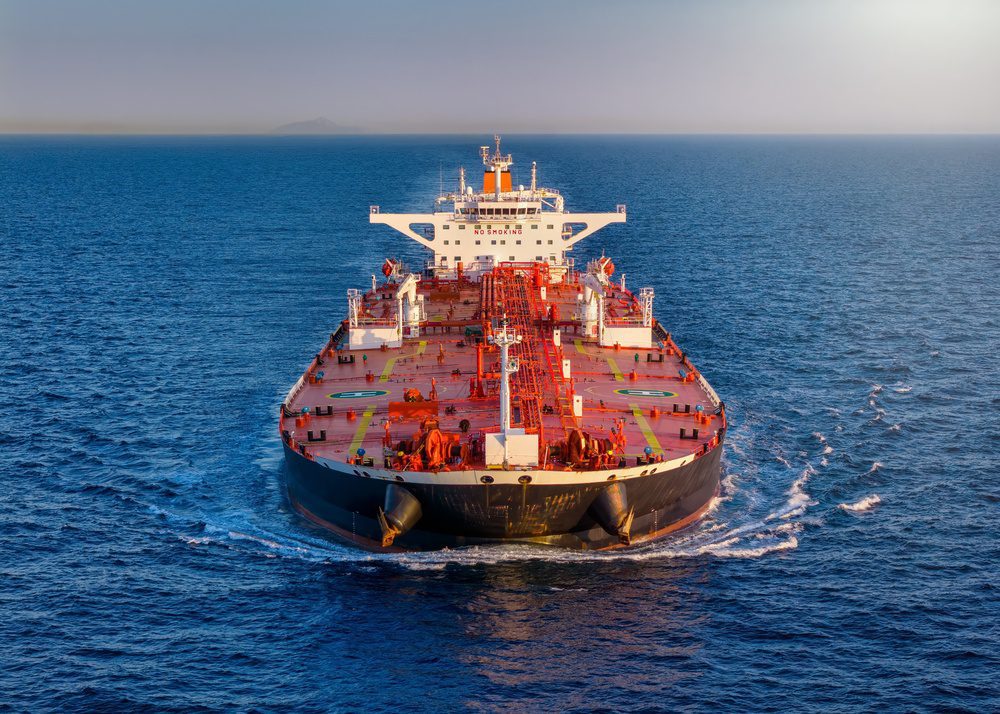
Tanker traffic is now down more than 90% from normal levels – the largest disruption to global energy supply since the 1970s oil crisis.
Roughly one-fifth of all the world's seaborne oil normally moves through that 24-mile-wide channel.
Nearly 20% of the world's liquefied natural gas moves through it too.
So does one-third of the world's seaborne fertilizer trade.
QatarEnergy declared force majeure on all LNG shipments after Iranian attacks on its facilities – pulling roughly 20% of global LNG supply off the market in a single announcement.
Nearly a million metric tons of fertilizer are physically stranded on ships inside the Gulf right now, unable to move.
Urea – the compound that feeds American corn and wheat crops – jumped 32% in a single week after the war began, from $516 per metric ton to $683, according to CSIS.
One ton of urea now costs U.S. farmers the equivalent of 126 bushels of corn – up from 75 bushels just last December.
The American Farm Bureau Federation, alongside 54 other agricultural groups, wrote directly to Trump this month: the Strait closure had hit "a farm economy that already had its back against the wall."
Planting season is now.
Why Diesel Prices Above $5 Mean Your Grocery Bill Is About to Get Worse
There is no strategic fertilizer reserve.
The pipeline Saudi Arabia built to route oil around the strait handles crude – not ammonia, not urea, not the compounds American farmers need in the ground in the next four to six weeks.
Analysts at Wolfe Research estimate the fertilizer disruption alone could add 2 percentage points to food-at-home inflation.
GasBuddy's De Haan projected that at the current pace, regular gas reaches $4.25 to $4.45 a gallon within two weeks – and diesel climbs to $5.80 to $6.05.
Diesel moves every truck on every highway between every farm and every grocery store in America.
Analysts at Macquarie Group put 40% odds on oil reaching $200 a barrel if the war extends into summer – which would push gas toward $7 a gallon nationwide.
TD Securities commodity strategist Ryan McKay told clients Thursday that with the conflict expected to last into deep April, the supply math is getting worse by the week.
It's Iran's blockade strangling the fertilizer supply, Iran refusing the ceasefire Trump said was offered – and then denying the offer ever happened.
To be fair the ceasefires previously offered to Iran backfired on Iranian leaders and they found out just how bad when they gathered to discuss them.
America’s word internationally paid a price thanks to a foreign ally dragging us into this conflict. Equally as bad American families are the ones paying the difference at the pump – and soon at the checkout line.
Trump says he'll end it in weeks.
Sources:
- Patrick De Haan, "Gas Prices Top $4 a Gallon Nationwide as Iran War Drives Record Surge," GasBuddy / The National News Desk, March 31, 2026.
- "Oil Prices Fall to Around $100 After Trump Indicates War Could End in Weeks," CNBC, April 1, 2026.
- "Stocks Fall, Oil Rises as Trump Comments Dent Hopes for a U.S.-Iran War Resolution," CNBC, April 2, 2026.
- "Trump's Iran War Speech Paints a Grim Picture for Oil Markets With More Than 600 Million Barrels at Risk," CNBC, April 2, 2026.
- "Hopes Dim for Swift End to Iran War After Trump Speech, Oil Prices Surge," Reuters / U.S. News, April 2, 2026.
- Emma Curtis, Joely Virzi, and Caitlin Welsh, "Chokepoint: How the War With Iran Threatens Global Food Security," CSIS, March 11, 2026.
- "Iran's Hormuz Blockade Leaves Fertilizer Stranded as Food Price Inflation Nears," Food Ingredients First, March 2026.
- "Iran War Brings More Economic Pain for American Farmers," NBC News, March 27, 2026.


