
Marine One Just Came Within Seconds Of Repeating The Crash That Killed 67 People
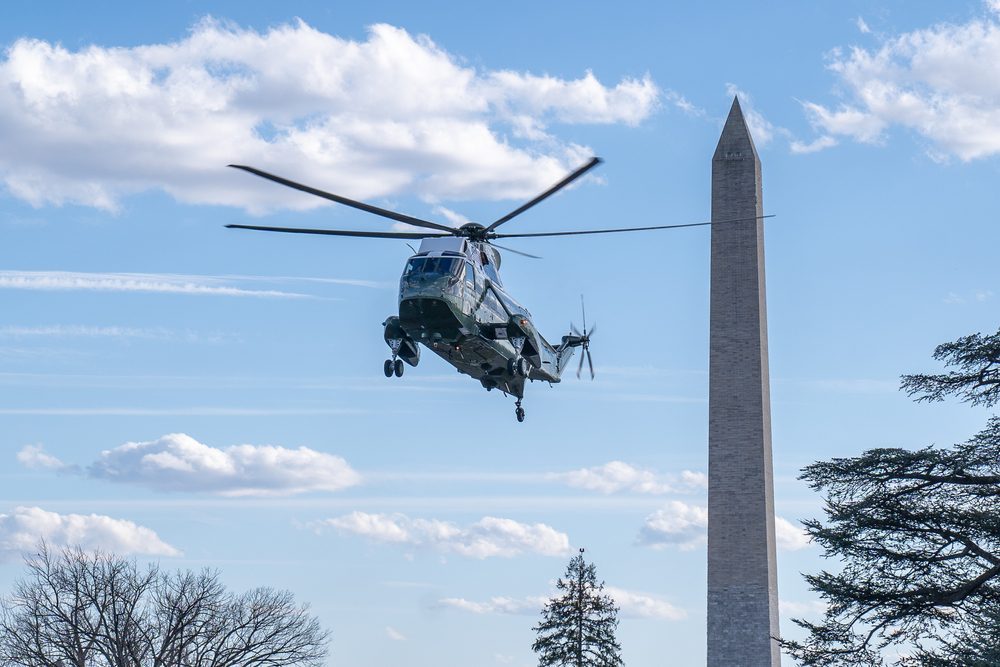
Sixty seven people died over the Potomac when an Army helicopter slammed into a passenger jet.
Eighteen months later air traffic control let it happen again with President Trump in the air.
Marine One carrying the President almost became the next deadly disaster in that same airspace.
FAA Confirms Marine One And A Passenger Jet Lost Safe Separation
On the afternoon of August 5, President Trump boarded Marine One at the White House for the short hop to Joint Base Andrews.
One minute later an Envoy Air regional jet lifted off the runway at Reagan National.
Within moments the two aircraft were closer together than federal law allows.
The FAA requires 1.5 miles of lateral separation and 500 feet of vertical separation between aircraft in that corridor.
Marine One and Envoy Air 3742 came in at roughly 0.8 miles apart and 700 feet of vertical clearance.
That is a "momentary loss of separation," in the FAA's own words.
In plain English, the President of the United States was flying closer to a commercial jet than federal rules permit.
The FAA now admits it, and NTSB investigators are on the case.
The Same Broken Tower Nearly Failed Again
This is not a new problem, and that is exactly why it should make you furious.
In January 2025 an American Airlines regional jet and an Army Black Hawk collided in that same stretch of sky, killing 67 people.
Federal investigators later found the Reagan National tower was short staffed that night, running one controller instead of two on a shift juggling both helicopter and airline traffic.
The NTSB spent months documenting years of near misses at that airport that Washington bureaucrats ignored until people died.
Marine One's own pilots reportedly issued repeated radio warnings about their takeoff path.
Reagan tower controllers did not process those warnings before the Envoy Air jet was already rolling.
The White House says Marine One flights are "piloted by some of the best aviators in the world" and that "at no point was the President in harm's way."
Maybe so.
But the President of the United States should never have to rely on his own pilots outflying a tower that still cannot get basic separation right, eighteen months after the deadliest air disaster in decades happened in that exact corridor.
Duffy Is Trying To Fix What Buttigieg Left Broken
Transportation Secretary Sean Duffy inherited an air traffic control system running on decades old equipment and chronic controller shortages, and he has spent this year pushing to modernize it.
He has publicly pressed for upgraded radar, more controllers in the pipeline, and faster technology in the corridors the NTSB has flagged as dangerous.
Pete Buttigieg ran that same Transportation Department for four years and left the FAA short staffed at the busiest, most dangerous airspace in America.
Now the man cleaning it up almost had to explain why the sitting President was on board when that same broken system slipped again.
Duffy did not create this mess, he was handed it, and the fact that Marine One survived a near miss instead of becoming a headline like the one from January 2025 is not luck the country should keep testing.
This is the reason Trump officials have pushed so hard, so fast, to overhaul air traffic control instead of accepting Washington's usual excuse that reform takes years.
Every day that tower runs on the same staffing and the same equipment that failed in January 2025 is another day this could happen again, and next time the President might not be the one who gets close enough to make the news.
Sources:
- Nick Arama, "Helicopter Carrying Trump Almost Had a Huge Problem in D.C. Airspace," RedState, August 5, 2026.
- The Daily Caller Staff, "FAA Investigates Safety Incident Involving Helicopter Carrying Trump," The Daily Caller, August 5, 2026.
- Kush Desai, White House Statement on Marine One Safety Incident, August 5, 2026.
- Cassandra Nolan, FAA Statement on Marine One Loss of Separation, August 5, 2026.
- National Transportation Safety Board, Final Report on January 2025 Midair Collision Near Reagan National Airport, February 2026.


